

Almost half of Apple’s WWDC 2026 keynote was dedicated to Apple Intelligence. The company had tried to kickstart its massive AI revamp two years ago, but the effort stalled. Now, though, many of the promises it made will soon be in your hands. The question is: do we actually want this new reality for our iPhones?
For Apple’s part, it censured the industry for “racing forward, seemingly pursuing AI for the sake of AI, without clear regard for the people – all of us – that it’s ultimately meant to serve.” You might argue Apple would have been there too, had its early efforts not faltered. And judging by what was announced, while it is still possible to draw distinctions between Apple and its rivals, there are plenty of cases where Apple is now doing the very things that made AI so divisive.
Apple Intelligence: The good
The announcements that most clicked with me – aside from Apple’s inevitable claims about respecting privacy more than everyone else – involved efficiency. Many new Apple Intelligence features are designed to handle tedious tasks and help you work faster within your own personal context.
One simple example is rearranging Safari tabs into topics. Another is web page monitoring, freeing you from constantly checking whether a site has changed. Neither idea is new, but Apple’s privacy stance makes its implementations feel trustworthy.
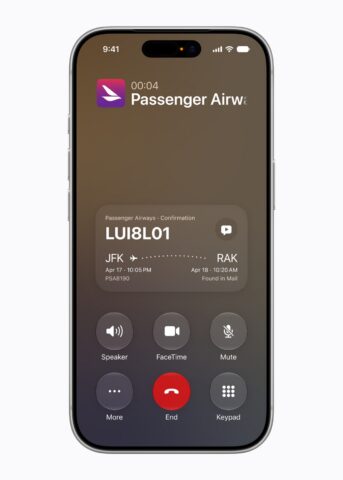
Beyond that, Apple showed off back-and-forth digital assistant flows reminiscent of the original (pre-Apple) Siri demos, but at scale. Being able to ask Siri in natural language to find useful information and make suggestions during an ongoing conversation could be a genuine time-saver. Having your iPhone dig out relevant details from your email during a call (see above) could be huge. And there’s plenty more where that came from, including smart calendar event creation, attachment suggestions in Messages, and tools to generate custom Safari extensions and Shortcuts, based on your needs.
Apple Intelligence: The bad
But it’s not all good news, largely because of the very nature of AI itself. The revamped Visual Intelligence, for example, looks useful, whether identifying a plant or using it for accessibility reasons. But at no point did Apple urge caution about the accuracy of its responses – a known weakness of AI. So probably don’t point your camera at a wild mushroom and ask if it’s safe to eat.
Concerns about accuracy extend elsewhere. Splitting bills. Gaining insights. Writing content from scratch. I don’t doubt Apple believes its systems work well, but experience suggests you’ll want to double-check almost every suggestion Apple Intelligence makes, which undermines its promised efficiency.

Then there are changes to Photos and Image Playground, which give me pause. Photos now lets you extend frames, which is arguably fine when used sparingly. But new Clean Up and Spatial Reframing tools create photographic “unreality” by, respectively, removing significant elements and adjusting perspective, with AI filling in the gaps.
Apple described these features as “super cool,” citing their mix of bleeding-edge technologies. Its additional claim that the results remain consistent with the original scenes rang hollow, given that AI is – at best – making educated guesses.
Apple Intelligence: The ugly
Image Playgrounds takes things further. What was previously a relatively harmless tool for creating personalized Memoji and simple cartoonish imagery is now a full-fat AI slop generator. It can produce “photorealistic” imagery from scratch or based on existing photographs. Aside from the resources (energy; water) required to generate such content, this raises familiar questions about training data, copyright, and whether such tools align with Apple’s long-standing support of creative industries.

AI slop generation.
The revamped writing tools are in a similar space. Every sentence generated by AI is built on patterns learned from vast amounts of existing content. As a writer, I’m not thrilled by that. But Apple’s approach raises other concerns. Beyond accuracy, there’s the issue of tone. Apple claims its AI writing can adapt depending on who you are contacting. Increasingly, it will be harder to distinguish whether any words you receive are accurate and authentic or the thoughtless output of a prompt.
In fact, there’s an overriding sense throughout Apple Intelligence that the company wants you to outsource your brain. For complex, time-consuming busywork, that’s fine. But do we really need to depend on AI for even the most basic of social interactions? Is it a good idea to train people to be less curious about the world around them?
That’s not to say these features won’t prove useful and popular. I’m sure they will. They demoed well too, although whether that reflects reality remains to be seen. But for all the shade Apple threw at rivals integrating AI, it ultimately spent a lot of WWDC explaining how it will be more like them, for better and for worse.