

The idea of an app solely for tracking daylight might seem strange. After all, you can explore sunrise and sunset times in Apple’s Weather. But there are benefits to a dedicated app – especially at a time of year when clocks are changing in many countries around the world.
Faster access to granular daylight information, including for dates far into the future, helps you more easily plan. Whether you need to be mindful of daylight times for wellbeing, safety, or photography, these apps are a boon.
Solstice (free)
Best for wellbeing and value
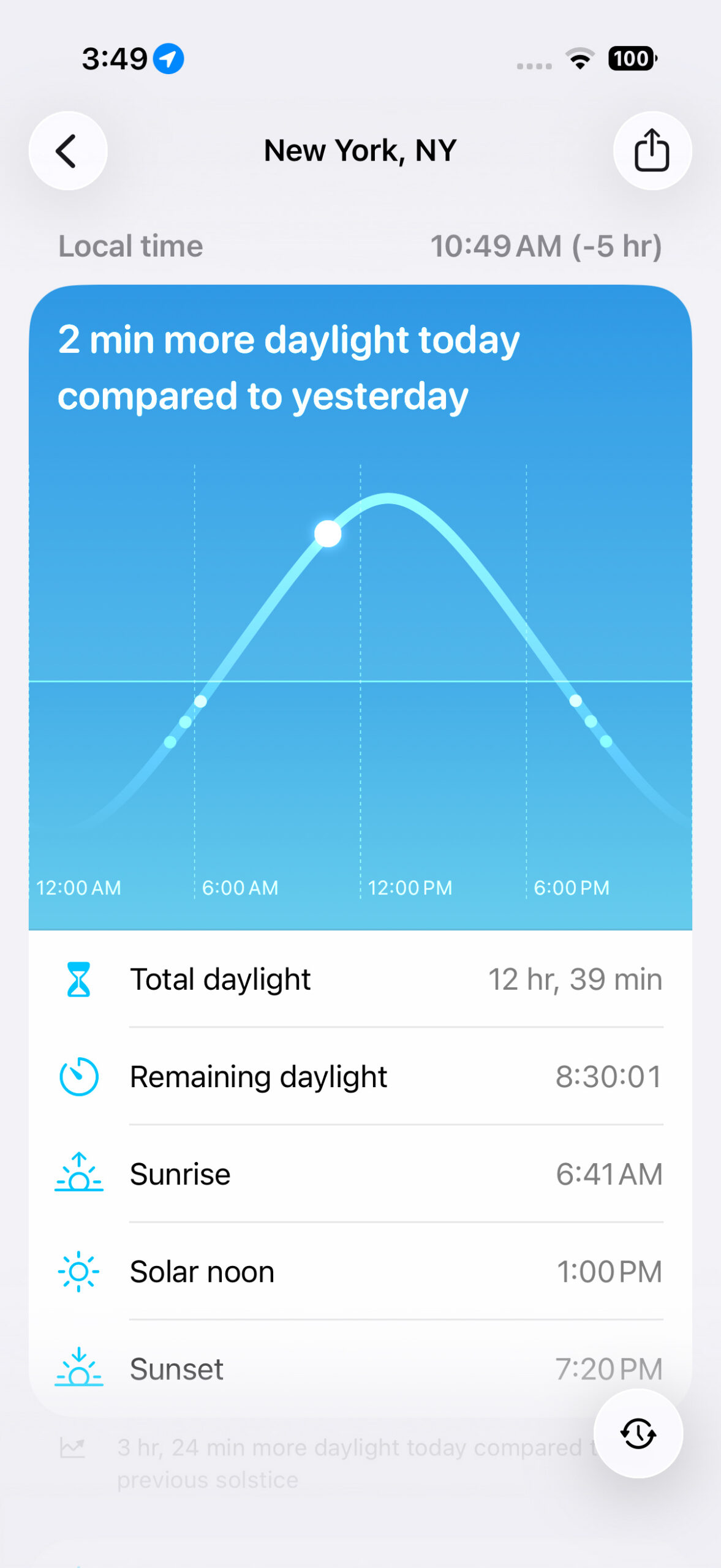
Select a location in Solstice and you’re met with a sleek, minimal page. A graph with a wiggly line tracks daylight progress. Beneath, you’ll find the day’s stats and monthly averages. It’s reminiscent of the expanded sunrise/sunset pane in Apple Weather.
However, Solstice provides good reasons to prefer it over Apple’s app. It’s immediate – you don’t have to hunt for information. And in the locations view, you can peruse daylight times across several places at once.
The app excels in the smaller details too. The graph has a line of text that compares today and yesterday in terms of daylight. You can “time travel” to different days. And there’s a setting to suppress notifications when daylight starts to decrease – something SAD sufferers will welcome.
Add smart widgets and the fact Solstice is free, and you’ve an ideal app for people whose main priority regarding daylight tracking is knowing how much daylight there will be on any given day.
Lumy ($7/£7)
Best for activities and visuals
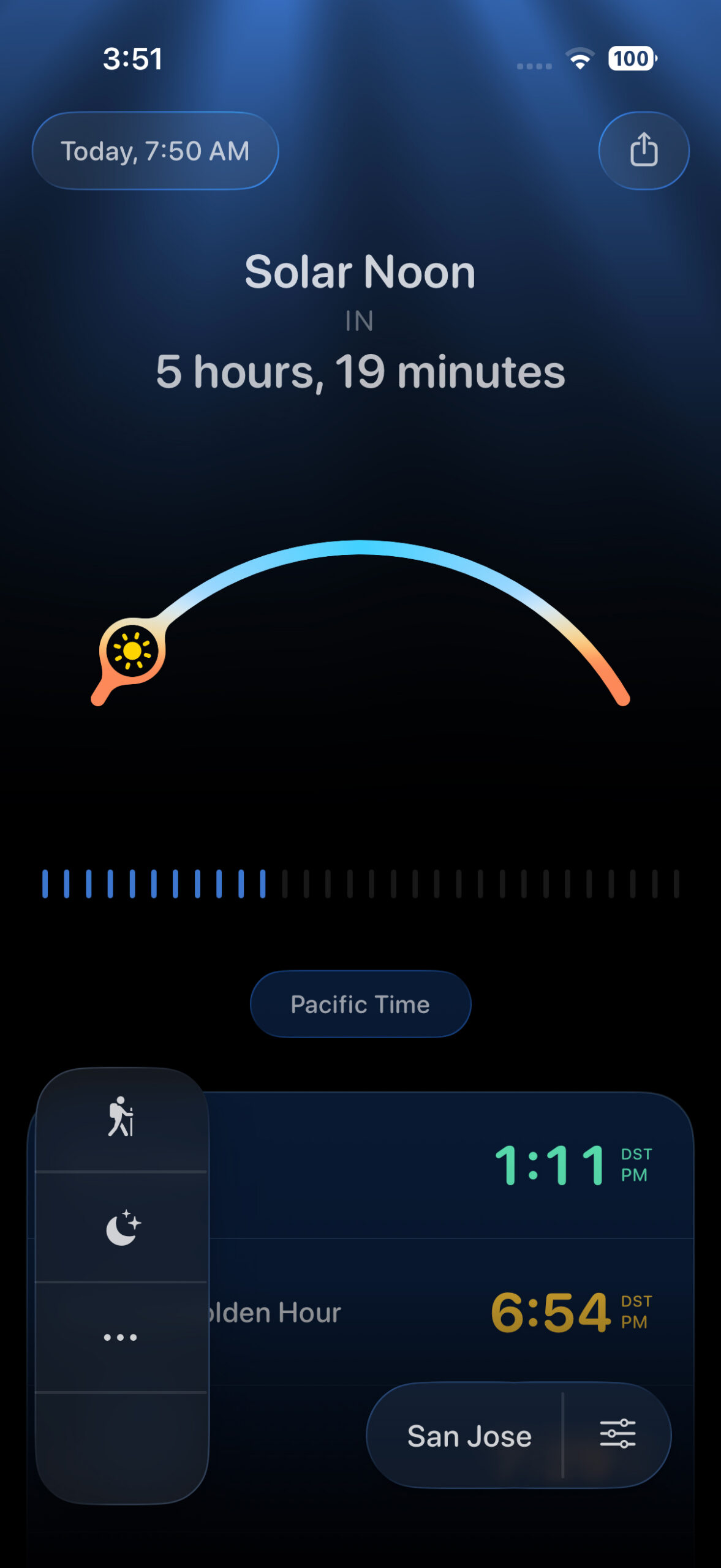
Many apps offer elegance and usability. Lumy also brings art. It’s the most visually arresting app of this collection, and it should come as no surprise that it looks swish on every device, from an iPhone to an Apple TV.
But this app isn’t mere eye candy. The single-pane view of the current location is contextual and dynamic, displaying what’s coming up rather than what’s already been – ideal when you’re partway through a day. Data points are color-coded, and a tap delivers extra details. They can also be used to trigger Live Activities and one-off or recurring notifications.
Customization extends further, notably with multiple modes that instantly change the main view to better suit your needs, whether that’s photography, mindfulness, hiking or moon watching.
The app’s unexpected depth, considering its refined and minimal design, adds significant value. If you prize immediacy and visual appeal in a daylight tracker, and can make use of the modes, Lumy is a first-rate choice.
SolarWatch (free or $13/£13 per year or $25/£25)
Best for photographers

SolarWatch’s central disc evokes a digital sundial. Its combination of daylight hours and weather conditions provides a valuable tool, especially for photographers seeking optimal moments to capture stunning shots.
The interactive dial helps you quickly access upcoming daylight data with a simple turn. You can save multiple locations as favorites and switch between them. Home Screen widgets provide easy access to data and discs.
That’s the free version. Optional IAP expands the app’s scope. An augmented reality (AR) view overlays the sun’s path onto what your camera can see, and a top-down map illustrates the sun’s direction at any given time. Furthermore, it adds granular notifications with offsets, so you could set a repeating alert 30 minutes after sunrise, ready for your daily morning walk.
Whether you’re a photography enthusiast or not, SolarWatch’s thoughtful design makes it well worth exploring – regardless of whether you stick with the free app or plump for the paid extras.
Sun Surveyor ($10/£10)
Best for plotting paths and using maps
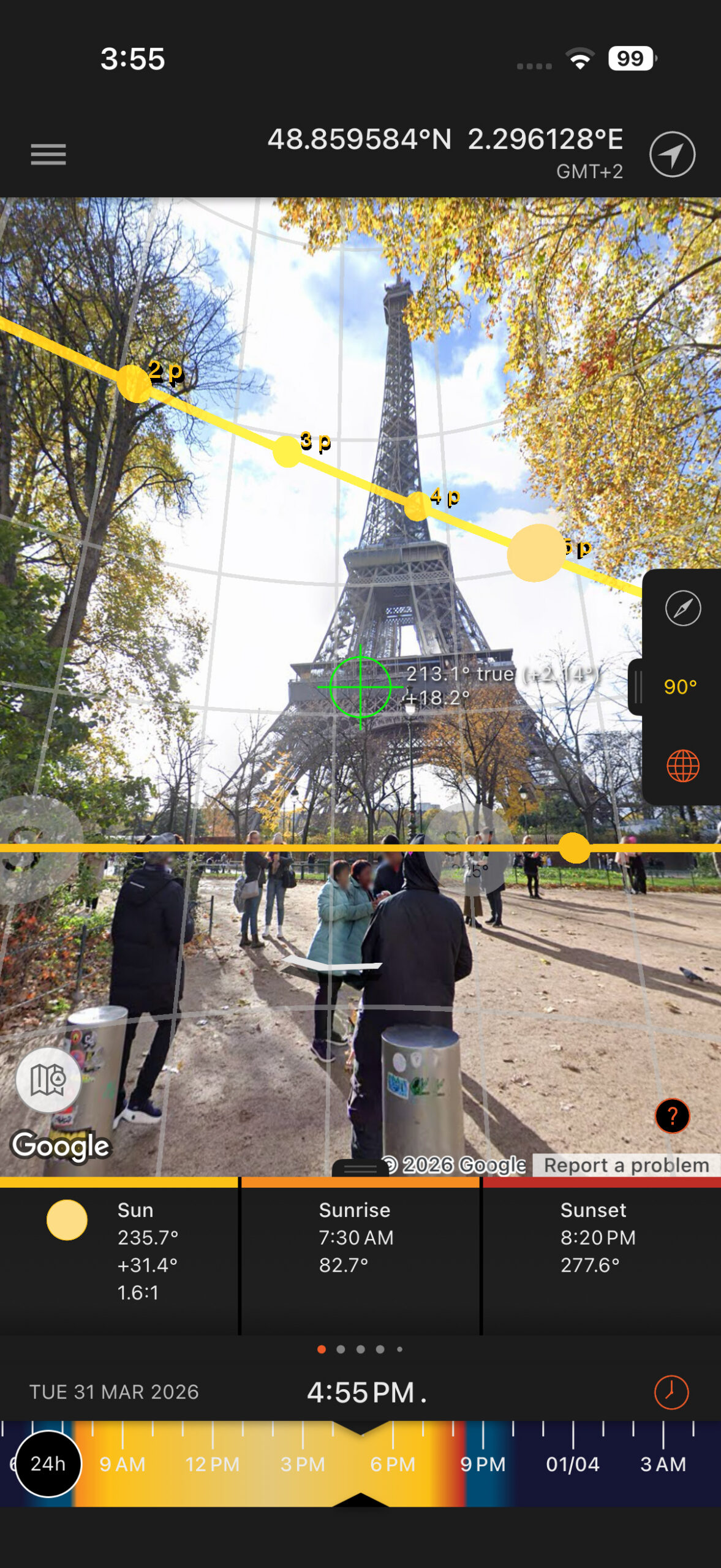
This app takes path-tracking elements seen in apps like SolarWatch to another level. Consequently, it best serves anyone keen to scout locations, such as filmmakers, gardeners, and prospective homeowners assessing the sun’s trajectory over a property.
You start with a 3D compass that shows the sun’s path throughout the day. The area below lets you swipe between data points, including golden hour times, nighttime photo opportunities, and shadow lengths. Elsewhere, map and live views provide added flexibility and features. And Street View overlays the sun’s progression onto any Google Street View scene.
This is clearly a specialized app, and the interface can sometimes be clunky. But when you need a deeper understanding of sunlight dynamics at any specific location, it’s a useful tool. If you’re unsure whether it’s for you, Sun Surveyor Lite offers limited demos of all the key features.
Also consider…

Max Daylight (free) began as a practical tool to help its creator get home before dark on bike rides, before adding in “everything solar but the kitchen sink.” Despite packing in a huge amount of data, it rarely feels cluttered or overwhelming, even if it’s not exactly pretty. If you like having every conceivable solar stat available at a glance, this is an easy recommendation.
Daylights (free) takes a deliberately minimal approach, turning the digital sundial concept found in apps like SolarWatch into a clean, scrollable calendar. You can tap any day for more detail and switch locations via a slightly fiddly globe. But the appeal is that big-picture view and seeing how daylight shifts over time.
Alpenglow (free or $15/£15 per year or $25/£25) wraps important daylight data and sunlight path maps in a slick interface, but unique features take things further. Tap the globe and you can browse or contribute sunrise and sunset photos. And the Times and Outlook tabs house predictions about the quality of sunrise and sunset. Paying unlocks longer-range forecasts, alerts and widgets.