

In March, Apple unveiled the MacBook Neo. This laptop marks a notable shift. Its starting price of $599/£599 ($499/£499 for education) sits well below anything we’ve previously seen from Apple in the laptop space and is aggressively competitive in the wider market. In spirit, it does for MacBooks what the Mac mini did for desktops back in 2005, providing an affordable and accessible entry point into the Apple ecosystem.
There are compromises, of course, but the MacBook Neo is far from bargain-bin hardware. The design and build quality remain unmistakably Apple. The display and keyboard outperform rivals at this price. And the laptop delivers plenty of power for the tasks most people do on a daily basis.
What’s interesting is how the MacBook Neo is powered. Inside sits the same chip used in the iPhone 16 Pro. That raises an obvious question: if a Mac laptop can run on an iPhone chip, what does that mean for the iPhone itself?

MacBook Neo is powered by an iPhone chip.
An A-series chip designed for Mac
The MacBook Neo’s main limitations stem from the A18 Pro chip. Notably, there’s an 8GB RAM ceiling that affects both multitasking clout and how well the machine will hold up over time. And like most chips designed for smartphones, the A18 Pro prefers short bursts of performance rather than the sustained workloads that are more commonplace on laptops and desktops.
Apple would naturally point anyone needing more power toward the now mid-range MacBook Air. But if the MacBook Neo receives annual refreshes, the trajectory becomes interesting.
A 2027 model would logically run the A19 Pro found in the iPhone 17 Pro. That would mean a RAM bump to 12GB, immediately addressing the Neo’s biggest weakness. Assuming this pattern continues, the entry-level MacBook would lag roughly 18 months behind Apple’s flagship iPhone in terms of Apple Silicon.
And if the MacBook Neo becomes the hit many expect, Apple will increasingly be motivated to ensure the chip is capable enough for laptop duty. That could mean future A-series chips like the A20 Pro pushing to 16GB of RAM and delivering better sustained performance. Any such improvements made to keep the MacBook Neo competitive would also make iPhones more powerful and longer-lived.
A more capable iOS
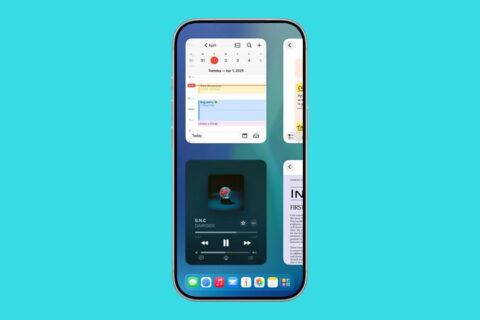
Don’t expect this on your iPhone anytime soon.
Even though the MacBook Neo proves macOS can run on an iPhone chip, that doesn’t mean macOS – or even iPadOS – will ever officially come to your iPhone. Apple famously likes to ring-fence devices, tailoring software to specific form factors – which conveniently also “encourages” you to buy more hardware.
However, in starkly exposing arbitrary and artificial software limits in this way, Apple creates a tension. When people know the same chip powers a MacBook and an iPhone, expectations change. People may reason that if a MacBook Neo can do something, why can’t their iPhone do the same? For example, if an iPhone chip can run desktop software, why can no iPhone run desktop-style workflows?
Apple would argue that multitasking with multiple windows on an iPhone makes no sense – and for now, that’s true. But things get murkier when you look at future devices like the upcoming iPhone Fold. With an inner display that’s almost identical in size to the iPad mini’s, iPad-style multitasking feels like an obvious fit.
Instead, Apple is reportedly experimenting with new layouts that sit somewhere between iPhone and iPad ones, because of course it is. That means more workload for developers and more interface nuances for users to learn. But there’s little reason for this level of stubbornness beyond the obvious – if you want iPad-style workflows, Apple would rather you buy an iPad in addition to your iPhone. However, this stance becomes even more problematic the moment an iPhone gets plugged into something else.
External display support
Apple recently released a pair of 5K Apple Studio Displays – its first new monitors in years. But there’s a catch when you plug a MacBook Neo into one. Rather than driving the panel at its full 5K (5120 × 2880 pixels) resolution, you instead get a scaled up 4K (3840 × 2160 pixels) image. You can imagine Apple wanting to fix that in the future, giving every MacBook full 5K output.
Should that happen, we’re back to the same argument: if a future MacBook Neo can optimally output to a 5K display, why can’t an iPhone with the same chip? There would be no technical limitation – it would purely be Apple making that decision in software.
In other words, the barrier would be Apple choosing to not give high-end iPhones this level of flexibility. Interfaces could remain adaptive, behaving like an iPhone in the hand, but like iPadOS when connected to a display. You’d see a pointer and windowed multitasking, rather than merely a mirror of what’s on the iPhone screen. Your iPhone could become your computer. Whether Apple will ever allow that is another thing entirely.
Desktop-grade apps and games

If an iPad mini can do this, why can’t an iPhone Fold?
In the possibly unlikely event Apple moves in that direction, the software implications are huge. The iPhone already has an ambitious app ecosystem, especially for creative work. But desktop apps often go further, simply because they have more screen space to play with.
As more developers optimise software for Macs powered by iPhone chips, it’s possible they’d find it relatively easy to justify the extra work of optimising these same apps for iPhone. And since we now know iPadOS and iOS are the same, there’s potential for more iPad-first apps to gain an iPhone mode too. But that only works if Apple gives its iPhones some kind of desktop mode.
Games may have a clearer – and simpler – opportunity. Early experiments with the MacBook Neo show it running a wide range of games surprisingly well. Many aren’t available on the iPhone today, but we can now see that the hardware is capable of running them. That could encourage more developers to bring titles across, including AAA games that unexpectedly run on iPhone-grade Apple Silicon, along with indies that previously ignored the platform entirely.
Mac to the future
The MacBook Neo could change everything and do far more than just make Macs cheaper. It could upend Apple’s entire hardware hierarchy.
Apple’s most affordable products are often its best sellers. If the Neo follows that pattern, we could soon find that the world’s most popular Mac runs an iPhone chip. For the first time, the Mac would begin leaning on the iPhone for its technological foundation. A-series chips would be the baseline architecture for Macs, with M-series chips scaling things up for more powerful hardware and demanding use cases.
That leaves the iPhone in an interesting place. Not just a phone, but a pocket computer powerful enough to switch between different environments. Apple has resisted that idea for years. The MacBook Neo suddenly makes it feel a lot less far-fetched.