- A 7.6-inch inner display in a passport-sized body – Apple’s thinnest iPhone when open
- iOS 27 rebuilt for two screens, with Split View multitasking on iPhone for the first time
- $1,999 to start, and two rear cameras where the Pro has three
Apple has been rumored to be working on a foldable iPhone for the better part of a decade, and now it’s official. It’s called the iPhone Duo and it’s set to land into a set of badly-photoshopped gigantic hands near you later this year.
It closed out the “Surprise and shine” keynote as the headline act, with John Ternus handling the reveal himself in his first event as CEO. He opened by picking apart what’s gone wrong with rival foldables – devices that feel like two phones stuck together, in his framing – before making the case for Apple’s take. Whether the Duo earns that confidence is a question for reviews. Here’s what Apple has actually built.
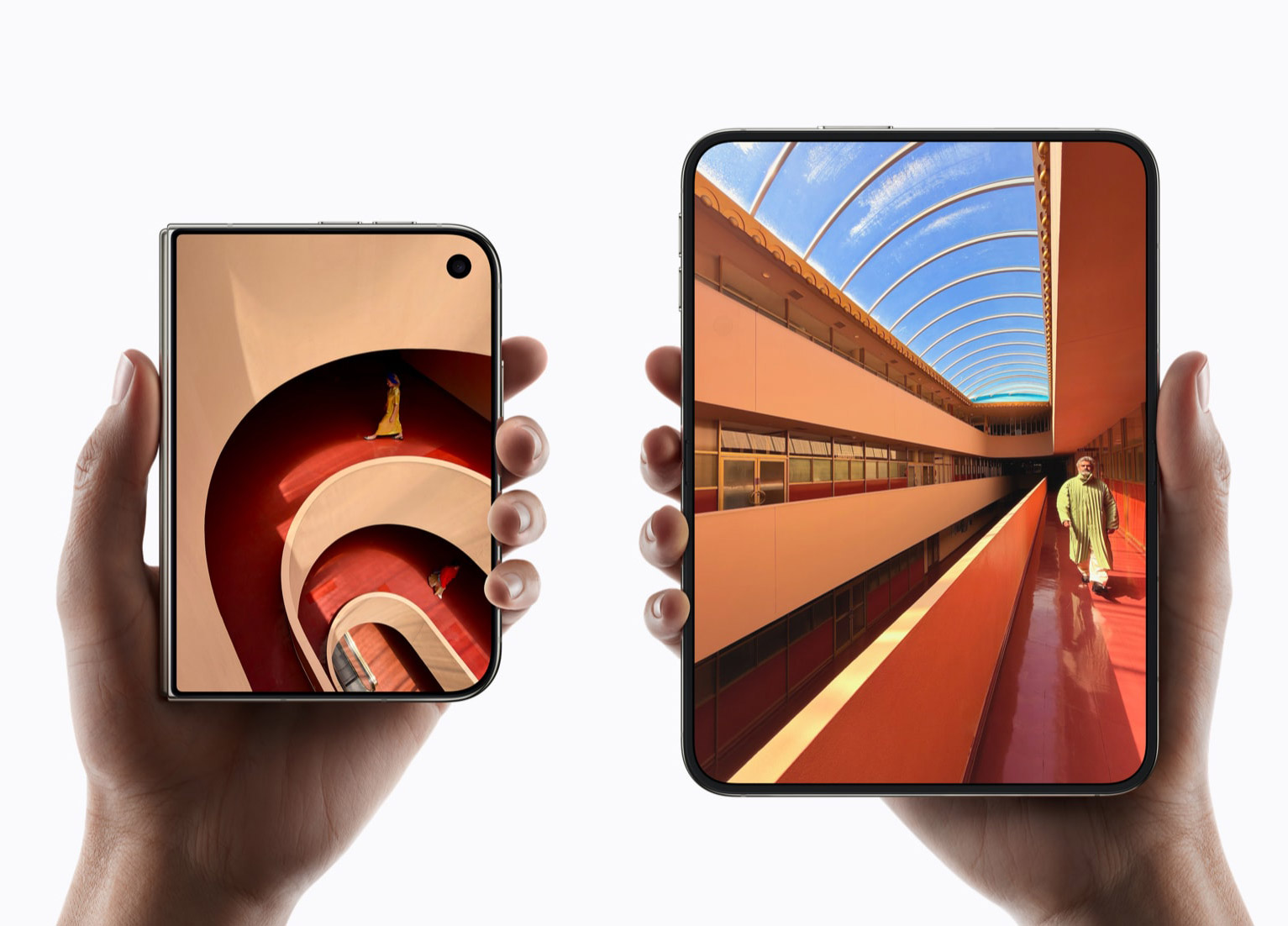
Closed, it’s passport-sized to fit neatly in one hand – an asymmetric shape with rounded corners on the right, like a short, wide iPhone. Whether Apple has spared a thought for left-handed folks remains to be seen.

The 5.4-inch outer Super Retina XDR display covers 90 percent of the screen area of an 18 Pro, so it works as a normal phone rather than a compromise you put up with. Open it and you have a small iPad: a 7.6-inch inner display, half again as large as the Pro Max, and Apple’s thinnest iPhone in that configuration. Both screens share the same aspect ratio, so content scales rather than reflows, and both get ProMotion, Always On, and 3,000 nits of peak outdoor brightness.
Touch ID moves to the side button – there’s no Face ID here – though you can also unlock it with an Apple Watch. Two colors: star white and night sky.
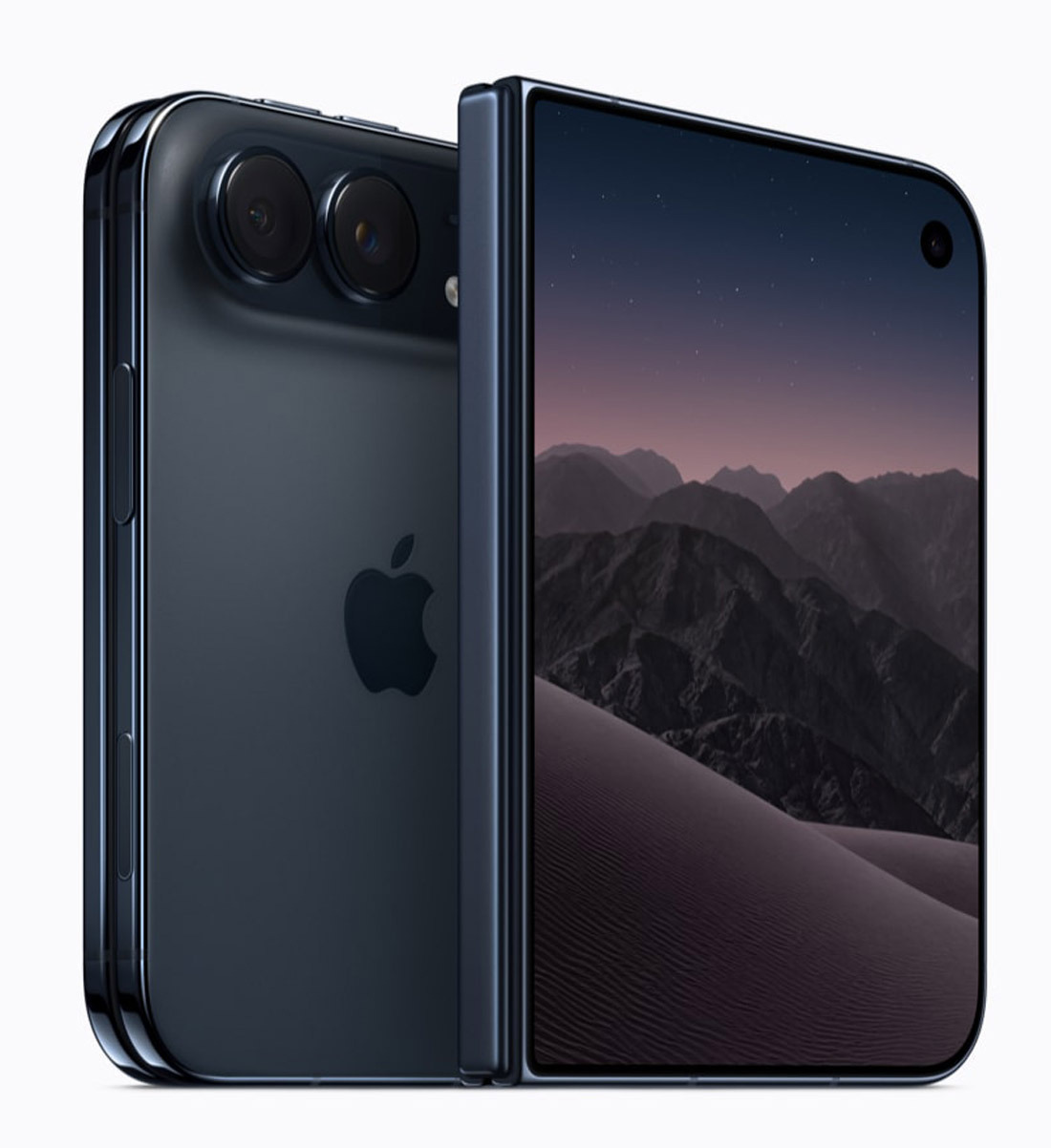
The most quietly interesting piece of hardware is the FaceTime camera, which sits beneath the inner display and stays hidden until you need it. That’s a first for Apple, and it’s hard not to wonder how long before it turns up on the regular models.
Apple spent real time on durability, and the detail backs it up. The enclosure is grade 5 titanium with a mirror-polished finish and a 3D-printed hinge cover. Ceramic Shield protects the back, Ceramic Shield 2 the front with three times the scratch resistance of the previous generation, and the whole thing is IP68 rated.
The hinge alone runs to more than 100 components, with internal support ribs and ceramic fiber inserts in the antenna splits that Apple says are three times stronger than the titanium around them. The inner display sits between layers of high-strength glass, held with adhesives that let those layers slide past each other like pages in a book so the bend doesn’t put stress on the panel.
The software has been rebuilt around the shape. Lock Screen controls, the Dock, and in-app navigation all shift to the side to free up vertical space, and the Dynamic Island is redesigned to run vertically along the edge of both displays. Open the Duo and you get two Home Screen pages with Today View down the left.
Split View puts two apps side by side on an iPhone for the first time. You can run two windows of the same app, save app pairs to return to later, and hold a Siri conversation on one half of the screen while you work on the other. Content reacts as the device folds, reorients when you turn it, and jumps to the right display when you flip it over. StandBy gets a proper upgrade too – set it down on either screen, even off charge, and it becomes a clock, photo frame, or widget hub.

Netflix, Zoom, and Slack have already shipped layouts built for it. Apple Pencil support arrives later this year rather than at launch, and it’s Apple Pencil with USB-C specifically.
Then the compromises. There are two rear cameras where the Pro has three: a 48MP Fusion Main and a 48MP Fusion Ultra Wide, the latter the same unit as the 18 Pro. The Main has an integrated optical-quality 2x telephoto rather than a dedicated telephoto lens, so you lose the reach the Pro Max gives you. Apple makes no claim of variable aperture here either – the headline feature of a phone costing barely half as much.
It’s the same camera system minus one entire camera, on Apple’s most expensive iPhone.
What the Duo does have is a set of camera features that only work because of the hinge. Duo Preview puts a live preview on the outer display so your subject can see their own framing. You can shoot a selfie on the better rear cameras and check it on the front screen. Smart Take uses on-device models to fire the shutter automatically when everyone’s posing, rather than making you race a timer.
Duo FaceTime lets someone standing next to you join a call on the outer screen. And Kid Cue plays Peanuts animations on the outer display to get a small child looking at the lens, which is exactly the sort of idea only a foldable allows.
A20 Pro is the same chip as the 18 Pro, driving both screens through a new display engine and paired with a custom vapor chamber for up to 35 percent better sustained performance than the 17 Pro. The C2 modem, N1 networking chip, and an eSIM-only design worldwide free up internal space for two batteries, one on each side, which Apple’s rebalancing algorithms treat as a single unit.

That gets you up to 44 hours of video playback on the outer display and 31 hours on the inner one. Set against the 18 Pro’s 36 hours and the Pro Max’s 45, the inner display costs you real endurance, and mixed use across both screens lands at 24 hours per charge. Roughly three times the screen area of a normal iPhone has to come from somewhere. Charging reaches 50 percent in around 20 minutes wired, or 30 minutes on MagSafe.
It looked great, but it looked great in the controlled conditions of a keynote. Apple’s own wording is worth reading closely: the matte nano-texture finish is described as minimizing how visible the crease is, not removing it. You certainly can’t see it in the footage, to the extent that it’s hard not to wonder how much of that was rendered. Durability and real-world wear are the open questions, and they don’t get answered until these are in people’s hands.
What’s clear is that this is the most ambitious thing Apple has built in years, and the hardest to make a straightforward case for. You’re paying a substantial premium for a bigger screen and a new set of things to do with it, while accepting a weaker camera and shorter battery life than a phone costing half as much. Whether that’s a trade worth making depends entirely on how much you want the large display, and how well the hinge holds up over a couple of years. We’ll know more once these are out in the world.
Pricing and availability
iPhone Duo starts at $1,999 for 256GB, which lets Apple say it came in under the $2,000 everyone had pencilled in. That base capacity looks thin in 2026 and thinner still for the cutting-edge buyers this is aimed at, though storage runs to 2TB at the top end.
Pre-orders open Friday, October 16 in more than 70 countries, with availability from Friday, October 23 and a further 28 countries on October 30. It ships with iOS 27.1 rather than the iOS 27 build arriving on other iPhones next week.
Two cases are built for the new shape: a two-part wraparound iPhone Duo Case at $79, and an iPhone Duo Folio with an integrated kickstand at $129. They slightly undercut how sleek the thing is on its own, but this is a big investment worth protecting. Both go on sale October 16.